Outpatient and inpatient alcohol treatment differ primarily in their structure and intensity. You’ll attend 1-3 weekly therapy sessions in outpatient care while maintaining your daily life and responsibilities, whereas inpatient requires 24/7 residence at a treatment facility with constant supervision and multiple daily sessions. Outpatient offers more flexibility but less support, while inpatient provides extensive care in a controlled environment. Understanding these key differences will help you determine which treatment path best suits your recovery needs.
Core Treatment Program Structures
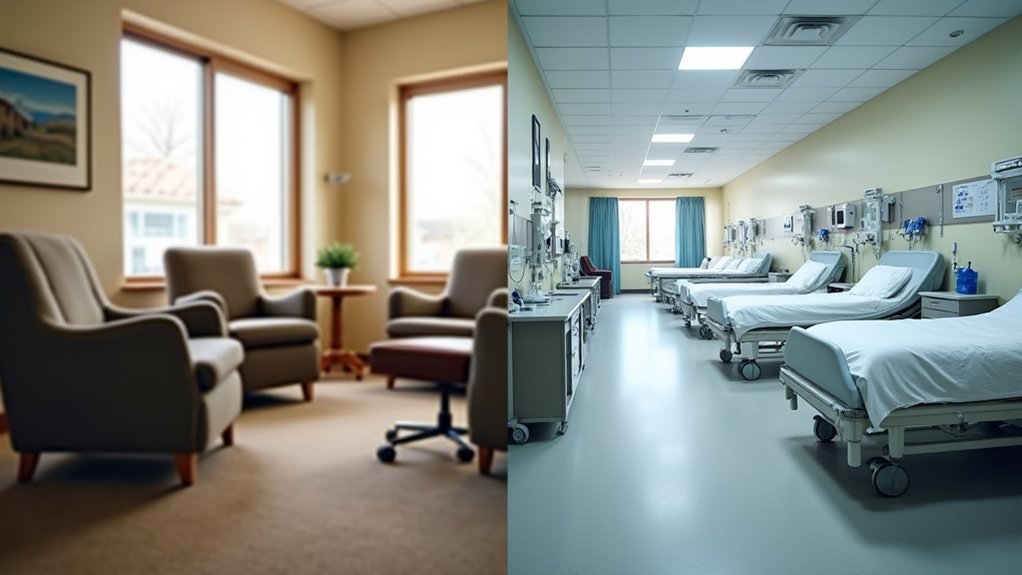
While both inpatient and outpatient alcohol treatment programs share the fundamental goal of recovery, their core structures differ markedly in intensity, duration, and delivery methods. In inpatient treatment modalities, you’ll experience a highly structured environment with 24/7 supervision, multiple daily therapy sessions, and thorough care that combines various therapeutic techniques, including individual counseling, group therapy, and holistic approaches. Most inpatient programs begin with medically assisted detoxification to ensure patient safety and comfort. Inpatient care provides continuous recovery focus throughout the entire stay, creating an immersive healing environment.
Outpatient services offer more flexibility, typically involving 1-3 weekly sessions while you maintain your daily responsibilities. The duration varies considerably inpatient programs usually last 30-90 days with full-time immersion, while outpatient programs can range from several weeks to months. Outpatient programs often include 12-step groups like Alcoholics Anonymous to enhance recovery outcomes. You’ll find that outpatient care emphasizes relapse prevention education and coping strategies, allowing you to practice these skills in real-world settings.
Daily Living and Residential Requirements
When choosing between outpatient and inpatient alcohol treatment, you’ll experience markedly different living arrangements that impact your recovery journey. While outpatient programs let you maintain your current residence and daily routines, inpatient facilities provide a controlled environment with 24/7 professional supervision and structured living. Your home environment’s stability and potential triggers become vital factors to contemplate, as outpatient treatment requires you to navigate real-world challenges while maintaining sobriety, whereas inpatient care offers a protective barrier from external pressures. Treatment programs typically match patients to levels of care based on thorough evaluations of their individual needs and circumstances. Studies show that remaining in either type of treatment for three months minimum leads to better outcomes in maintaining long-term sobriety. Outpatient treatment offers the added advantage of family support access, allowing loved ones to actively participate in the recovery process while patients live at home.
Housing Freedom Vs Structure
Since choosing between outpatient and inpatient alcohol treatment involves significant lifestyle adjustments, understanding the housing requirements and daily structure of each option becomes essential. Outpatient treatment offers greater housing autonomy, allowing you to maintain your current living situation while pursuing recovery. You’ll benefit from therapeutic flexibility as you attend sessions around your schedule and manage daily responsibilities independently. Research shows that the controlled environment of inpatient facilities helps reduce external distractions that could interfere with treatment progress. For enhanced security and monitoring, facilities employ security services similar to those used by major healthcare websites.
Key structural differences between the programs include:
- Outpatient lets you live at home while attending 10-20 weekly therapy hours
- Inpatient requires 24/7 facility residence for 30-90 days
- Outpatient maintains your independence in daily routines and transportation
- Inpatient provides structured schedules with continuous staff supervision
The choice between these options depends on your need for supervision, ability to manage independence, and existing support system at home.
Living Environment Stability
In contrast, outpatient treatment allows you to maintain your current living situation while attending scheduled therapy sessions. You’ll need to navigate potential triggers in your home environment and rely on personal support systems. If your living situation isn’t conducive to recovery, you might consider sober living arrangements to enhance stability. Your ability to manage daily responsibilities while staying focused on recovery will largely determine which treatment approach best suits your needs. The availability of flexible outpatient options through programs like PHP and IOP helps accommodate various lifestyle demands while maintaining therapeutic support.
Home-Based Recovery Challenges
While home-based recovery offers flexibility, it presents unique challenges that can impact your success in achieving and maintaining sobriety. Without structured support, you’ll face significant home challenges that can create recovery barriers, including unmonitored routines and limited access to professional therapy. With 40-60% of individuals relapsing during recovery, having proper support systems in place becomes crucial for long-term success. Support systems have been shown to improve accountability, motivation, and practical assistance during recovery. Individuals in rural areas face additional hurdles due to limited facilities spread across large geographic regions.
Research shows that structured environments, like sober living homes, yield better abstinence rates compared to standard home care. When you’re recovering at home, you’ll need to actively address these key obstacles:
- Limited access to immediate professional support and counseling
- Potential exposure to substance-using social networks
- Lack of consistent accountability and monitoring
- Reduced access to peer support systems and recovery resources
Understanding these challenges helps you develop strategies to strengthen your recovery foundation and seek additional support when needed. Consider supplementing your home-based recovery with structured outpatient programs to enhance your chances of success.
Level of Care and Clinical Support
While you’ll have 24/7 access to medical staff in an inpatient setting, outpatient programs typically offer support during scheduled hours with emergency contacts for crisis situations. Your treatment frequency varies considerably between the two options, with inpatient programs providing multiple daily therapy sessions compared to outpatient’s scheduled weekly or bi-weekly appointments. You’ll need to carefully consider your required level of medical supervision and crisis support, as inpatient facilities offer immediate intervention for withdrawal symptoms or health emergencies, whereas outpatient programs may require you to seek emergency services independently.
Daily Medical Staff Availability
When considering alcohol treatment options, the level of medical staff availability differs greatly between inpatient and outpatient programs. In inpatient facilities, you’ll receive 24/7 medical supervision from multidisciplinary teams, ensuring constant patient monitoring of your withdrawal symptoms and health status. Outpatient programs, while effective for many, provide limited medical access through scheduled appointments and shared specialists. Patients with severe addiction issues often achieve better outcomes through more intensive care provided by inpatient facilities. The cost implications reflect this care difference, with hospital stays averaging around $30,000 for comprehensive medical oversight.
Key differences in medical staff availability include:
- Inpatient programs offer immediate treatment adjustments based on real-time health changes
- Outpatient care relies on periodic health screenings, typically weekly or biweekly
- Emergency medical interventions are instantly available in inpatient settings
- Outpatient programs depend on external healthcare networks for urgent care needs
This distinction in medical staff accessibility can greatly impact your recovery journey, particularly if you’re dealing with severe withdrawal risks or complex health conditions.
Treatment Session Frequency Comparison
Three distinct patterns emerge when comparing treatment session frequency between inpatient and outpatient alcohol programs. You’ll find that inpatient care offers the highest therapeutic intensity, with daily sessions and round-the-clock supervision. Partial care programs provide structured daytime treatment while allowing you to return home at night. Outpatient options, including IOPs, offer more flexibility but still maintain session consistency through regular scheduled appointments. Both outpatient and IOP treatments can be highly effective for those with mild to moderate addiction severity levels. The recommended minimum duration for intensive outpatient treatment programs is typically 90 days to achieve optimal recovery outcomes.
| Program Type | Session Frequency |
|---|---|
| Inpatient | Daily sessions with 24/7 supervision |
| Partial Care | 6-8 hours daily |
| IOP | 3-5 days/week, 3-4 hours each |
| Standard Outpatient | Weekly or biweekly sessions |
| Residential | Multiple daily structured sessions |
Your treatment needs and life circumstances will help determine which frequency level best supports your recovery journey while balancing other responsibilities.
Access to Crisis Support
Because crisis support can make a vital difference in recovery outcomes, the level of care between inpatient and outpatient programs differs substantially in both availability and intensity. When you’re in an inpatient facility, you’ll have immediate access to crisis intervention through 24/7 medical staff and established emergency protocols. In contrast, outpatient programs rely on community emergency resources and your personal support network during urgent situations.
Key differences in crisis support between programs:
- Inpatient facilities provide round-the-clock medical teams for immediate response
- On-site staff can quickly address mental health emergencies or withdrawal complications
- Outpatient programs depend on external emergency services after hours
- You’ll need to coordinate with local hospitals for urgent medical needs in outpatient care
Your safety during crisis situations requires careful consideration when choosing between these treatment options, as immediate access to professional help can be essential for successful recovery.
Financial Investment and Insurance Coverage
Understanding the financial aspects of alcohol treatment can greatly impact your recovery journey, as insurance coverage and out-of-pocket costs vary substantially between outpatient and inpatient programs. You’ll find that outpatient services typically require lower upfront costs, while inpatient care involves higher expenses due to 24/7 supervision and accommodations.
Your insurance coverage through private plans, Medicaid, or Medicare will influence your financial responsibilities. Most insurance plans cover essential treatments, though you’ll need to verify network status and obtain pre-authorization. If you’re seeking financial assistance, be aware of insurance limitations – particularly with public insurance, which may restrict access to specialized programs. Remember that while basic treatment services are often covered, luxury amenities and holistic therapies usually require out-of-pocket payment.
Time Commitments and Schedule Flexibility

When choosing between inpatient and outpatient alcohol treatment, the time commitment required will greatly impact your recovery journey and daily life. Inpatient programs demand your full-time presence for 28-90 days, with structured daily activities and 24/7 supervision. In contrast, outpatient treatment offers greater scheduling flexibility while you maintain work or school commitments.
Key differences in time requirements include:
- Inpatient requires living at the facility, dedicating 8+ hours daily to therapy and group sessions
- Outpatient allows you to balance treatment with daily responsibilities, attending 1-5 sessions weekly
- Intensive outpatient programs (IOPs) typically meet 3-5 days weekly, often during evenings
- Standard outpatient care offers more flexible scheduling options, usually 2-4 hours per session
Both approaches require consistent attendance for successful recovery, though their commitment balance varies considerably.
Recovery Environment and Trigger Management
The recovery environment plays a crucial role in determining your success with alcohol treatment, as both inpatient and outpatient programs offer distinct approaches to managing triggers and maintaining sobriety.
In inpatient treatment, you’ll find yourself in a controlled setting away from environmental factors that might trigger alcohol use. You won’t have access to substances, and you’ll practice coping strategies in simulated scenarios under professional supervision. This protected environment offers constant support and monitoring to strengthen your recovery foundation.
Outpatient programs, however, expose you to real-world trigger exposure while you maintain your daily routine. While this approach presents higher relapse risks, it allows you to immediately apply coping skills in your actual environment. You’ll learn to navigate challenges within your home setting while relying on support groups and scheduled therapy sessions for guidance.
Support Network Integration

Support networks function differently across inpatient and outpatient alcohol treatment programs, with each approach offering distinct advantages for maintaining sobriety. While inpatient care creates intensive peer connections within the facility, outpatient treatment leverages your existing social connection dynamics and community support roles. Family engagement strategies vary greatly, with outpatient programs enabling continuous family involvement versus inpatient’s structured, limited interaction periods.
- You’ll maintain employment and daily responsibilities in outpatient care, integrating recovery into your routine
- Inpatient treatment provides 24/7 peer interaction benefits through shared living experiences
- Outpatient programs allow real-time application of coping strategies with family support
- Your relapse prevention methods will depend heavily on external support networks in outpatient care, while inpatient builds internal support systems first
Treatment Duration and Progress Monitoring
Understanding treatment duration and monitoring protocols represents a critical difference between inpatient and outpatient alcohol recovery programs. You’ll find inpatient programs follow a structured 30-90 day timeline with daily medical oversight, while outpatient services offer flexible scheduling that can extend for months based on your needs and progress.
| Aspect | Inpatient | Outpatient |
|---|---|---|
| Duration | 30-90 days fixed | Weeks to months variable |
| Monitoring | Daily assessments | Weekly/biweekly check-ins |
| Schedule | Rigid, full-time | Flexible, part-time |
| Progress Tracking | Clinical metrics | Self-reporting tools |
Your progress monitoring will vary considerably between programs. Inpatient facilities utilize standardized assessments and daily medical evaluations, while outpatient programs rely on regular check-ins and self-reporting tools to track your recovery journey. Both approaches include substance screening and personalized relapse prevention strategies.
Success Rates and Recovery Outcomes
Success rates between inpatient and outpatient alcohol treatment programs reveal distinct patterns that depend on multiple factors, including addiction severity and individual circumstances. Treatment adherence plays an essential role, with inpatient programs showing completion rates of 43-83%, while outpatient programs range from 50-77%. You’ll find that matching treatment intensity to your specific needs greatly impacts recovery outcomes.
- Inpatient programs demonstrate higher success rates for severe alcohol use disorders, particularly during the initial treatment phase
- Outpatient treatment proves more effective for mild to moderate cases when combined with strong support systems
- Your likelihood of completing treatment increases by 30% in structured inpatient environments
- Long-term success rates improve when you follow an extensive aftercare plan, regardless of treatment type
Research shows that both program types can be effective when properly matched to your addiction severity level and personal circumstances.
Frequently Asked Questions
Can Patients Switch Between Inpatient and Outpatient Programs During Their Treatment Journey?
Yes, you can switch between treatment programs based on your evolving needs and progress. Treatment flexibility allows you to shift from inpatient to outpatient care, or vice versa, depending on your recovery journey. Your clinical team will assess your progress, consider your patient preferences, and recommend appropriate changes. Many facilities offer hybrid options, making it possible to adjust your level of care as you develop stronger coping skills and maintain sobriety.
What Personal Items Are Allowed in Inpatient Versus Outpatient Treatment Facilities?
You’ll find stricter rules for personal belongings in inpatient facilities compared to outpatient programs. In inpatient care, you’re typically allowed essential items like basic clothing, travel-sized toiletries, and approved comfort items such as photos or journals. Outpatient settings are more flexible with allowed items – you can bring backpacks, electronics, and personal snacks. Both settings require that medications be in original containers and all items undergo security screening.
How Do Withdrawal Symptoms Differ Between Inpatient and Outpatient Treatment Approaches?
You’ll experience similar withdrawal symptoms in both settings, but the way they’re managed differs considerably. In inpatient care, you’ll receive 24/7 monitoring and immediate medical intervention for severe symptoms like seizures or delirium tremens. With outpatient treatment, you’ll need to self-monitor your withdrawal severity and seek emergency care if needed. While outpatient offers greater treatment accessibility, it may pose higher risks during acute withdrawal phases that require medical supervision.
Are Religious or Spiritual Practices Incorporated Differently in Each Treatment Setting?
You’ll find that faith-based integration varies considerably between settings. In inpatient treatment, you’re typically required to participate in structured spiritual counseling and group activities, with dedicated chaplains or religious staff guiding your journey. Meanwhile, outpatient programs offer more flexibility you can choose which spiritual elements to incorporate, and counselors work with your personal beliefs. You’ll have greater autonomy in outpatient settings to pursue religious practices that align with your individual faith preferences.
What Technologies or Apps Support Treatment in Outpatient Versus Inpatient Programs?
In outpatient programs, you’ll rely heavily on mobile applications and telehealth services for remote support, including video counseling sessions and self-management tools like sobriety trackers. While inpatient settings utilize technology more intensively with biometric monitoring and on-site systems, your outpatient experience focuses on portable, accessible tools you can use anywhere. You’ll have access to recovery apps, digital CBT modules, and peer support networks that help maintain your progress between scheduled appointments.